Twenty-five years on patrol, most of it night shift, and a good part of it standing in somebody's driveway at two in the morning taking a report about something that had already happened.
Here is what I learned doing that. Almost none of it was random. The people who got picked had done three or four small things beforehand without thinking about them, and the person who picked them had been paying attention long enough to notice.
That is the whole idea behind these books, and it is worth saying plainly before you read another line: the question being asked about your house is not whether somebody can get in. Most of the time he already knows he can. The question is whether anybody in there is paying attention.
This sample is two checks. Both are free. Both take about a minute. Both are invisible until you go and look, and neither is a secret — they are written down in places most people never have reason to read.
What this doesn't do
Nothing in these books makes a house impossible to get into, and I would not trust anyone who told you otherwise. What they do is make yours a worse choice than the next one, which is the only thing that has ever actually worked.
You will not find prices in the volumes. Prices go stale and a book that ages generates refunds instead of results. Anything with a number on it that can change lives on a separate dated sheet, and that sheet gets re-issued.
And there is one thing I will not print. I am not going to tell you what you may or may not do about a person on your property, what you may record, or where the lines sit on trespass. Those answers are different in every state and different again outside the country, and a book that guessed at them would get somebody hurt or arrested. When you need that answer, it comes from a local attorney, your county, a tenants' union, or your own non-emergency line — not from me.
None of what follows requires any of that. It is two things you can go and do tonight, in your own house, with the phone already in your pocket.
The mail somebody else can already be reading
The Postal Service runs a free service called Informed Delivery. Every morning it emails you scanned images of the outside of the letter mail arriving that day. Millions of people use it and like it, and it is genuinely useful — you know the check arrived before you walk out to the box.
Here is the part that almost nobody thinks through.
The account is attached to the address, and somebody has to claim it. If the person living at an address has never signed up, that address is sitting there unclaimed. It is the same shape as everything else in these books: a thing that is fine while somebody is paying attention to it, and quietly not fine while nobody is.
The Postal Inspection Service has been public about mail theft and about people attempting to enroll against addresses that are not theirs. The Postal Service has tightened it up since — there is identity verification now, and a letter goes out in the mail to the address whenever somebody tries to set one up. That is a real improvement and I want to give it its due. It also does not change what you should do, which takes a minute.
Your one-minute check
- Go to informeddelivery.usps.com — type it yourself. Not a link in an email, not a search result with an ad label on it.
- Sign up at your address. It is free. There is no subscription and nothing to cancel.
- Verify your identity when it asks. This is the step people abandon, and it is the entire point of the exercise.
- When the letter arrives at your house confirming the enrollment, you are done. The slot is yours.
- Then actually read the morning email for a week. You will learn something about your own mail either way.
If you get a confirmation letter for an enrollment you did not request, that is not junk mail and it is not a mistake. Keep it, and report it to the Postal Inspection Service at uspis.gov/report. That letter existing is the system working exactly as designed, and it is telling you something.
The tail that doesn't need a car
In the gas station video I said the habit that turns everything else into your home address is driving straight home without ever checking your mirrors. That is still true, and it is still the one I would have you take if you only took one.
But following somebody used to require being behind them.
Since 2024, Apple and Google have both implemented a shared industry specification called DULT — Detecting Unwanted Location Trackers. It is not a feature one company built and the other copied. It is a published standard the two of them agreed on, and it means a Bluetooth tracker of one brand can be detected by a phone of the other. Before that, an Android user simply could not be told about an AirTag riding along in their car, and that gap is the reason the standard exists.
Two things came out of it. The first is automatic: your phone will warn you if an unknown tracker has been moving with you for long enough. Most people have heard of that one.
The second is the one almost nobody knows about. Both phones will scan on demand, right now, and you do not have to wait for anything. And here is the part I found genuinely surprising when I went looking: the two companies put it in the same place, with the same name.
Your two-minute check
- Make sure Bluetooth is on. The scan cannot work without it.
- Open Settings
- Go to Safety & emergency
- Tap Unknown tracker alerts
- Tap Scan now — it takes about ten seconds.
That is an iPhone on iOS 17.5 or later. It is also an Android phone on 6.0 or later. Same four taps on both. On an iPhone you can also open Find My and scroll to the very bottom, where anything that has recently triggered an alert is listed.
If the scan finds something and it is not yours, do not go pulling a car apart in a dark driveway at eleven at night. Note the time and where you were. If your phone offers to make the tracker play a sound, that will help you find it. Holding an iPhone against one will open a page showing partial contact details for whoever registered it. Then take it to your non-emergency line, or to the police, and let them have it.
- A manual scan finds trackers that are near you and separated from the person who owns them. A tracker whose owner is standing in the same room is doing exactly what it was sold to do, and will not show up.
- It only finds trackers that follow the standard. Something homemade, or a cheap device that ignores the specification, is not covered by any of this.
- Alerts are cleared after about two days. If you think you saw one and went back later, it may simply be gone.
- Most hits are nothing. A tracker in a borrowed bag, in a rental car, on a set of keys somebody lent you, in a coat you are returning. One detection is a detection. It is not a finding.
That last point matters more than the other three, and it is the reason there is an entire module in Volume I about telling a real mark from a coincidence. A book that teaches you to see threats everywhere has made you worse off, not better. Most pebbles are pebbles.
What the two have in common
Neither of these is about breaking in. Neither of them involves a lock.
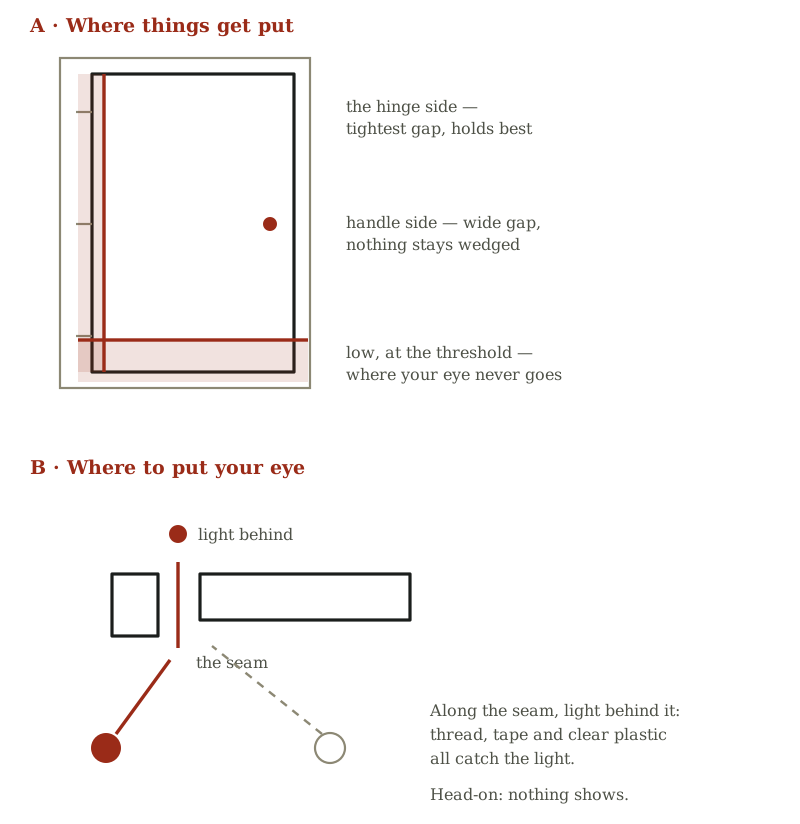
They are both about somebody learning your pattern without your knowing — one through the mail that comes to your door, one through a thing the size of a coin. That is the same thing the flyer wedged low in your door seam is doing, and the same thing a car two lengths back on your way home from the fuel pump is doing.
You are being learned, not attacked. Almost everything I know comes down to making that harder, and almost none of it costs money.
Both of these checks live in the books with the rest of it. The exact taps change when the phone companies move a menu, which they do, so the current version of those steps lives on a dated sheet that gets re-issued rather than in a book that would quietly go wrong.